
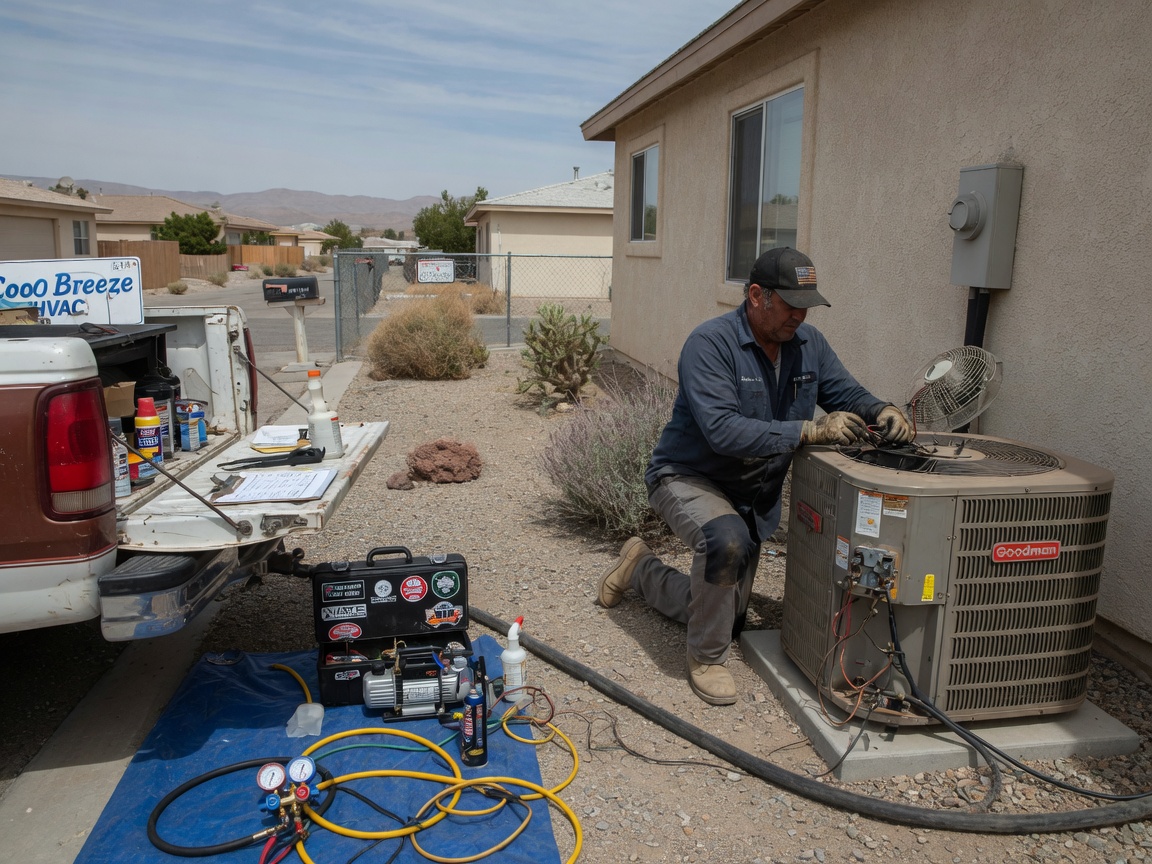
Pahrump sits in Nye County under constant summer heat that pushes residential AC units past their limits by late June. Homes in Calvada often have older rooftop packages installed when the neighborhood grew, and fine desert dust works its way into coils and motors faster than in Las Vegas subdivisions. Technicians here routinely find clogged filters and failing capacitors that would last longer in milder climates. Repair calls spike when overnight lows stay above 80 degrees and systems never get a rest cycle.
Common failures include seized condenser fan motors from dust abrasion and refrigerant leaks at flare fittings loosened by daily thermal expansion. Because Pahrump draws many retirees from the Las Vegas area, we see single-story block homes with minimal attic insulation that forces units to run longer cycles. A proper repair always includes cleaning the coil with non-acidic solution rated for desert conditions and checking the contactor for pitting before any refrigerant is added. Skipping these steps leads to repeat visits within weeks during peak heat.
Nye County building rules require proper recovery of refrigerant and documented leak repairs before recharging. Technicians carry manifold gauges and recovery machines on every truck because venting is not an option here. When a unit in a Calvada cul-de-sac loses cooling on a 110-degree day, the priority is restoring operation safely without overcharging a system already stressed by radiant roof heat.
Technician insight
In Pahrump the thing that catches most people out with AC repair is how quickly fine dust from the desert floor packs the condenser fins on rooftop units serving Calvada block homes. One season of 110-degree days plus constant wind can drop airflow enough to trip high-pressure switches, and homeowners often replace the capacitor twice before realizing the coil itself needs attention.
Rooftop unit failure on a Calvada cul-de-sac
Homeowner reported no cooling after three days of 108-degree highs. We found the contactor welded shut and the condenser coil blocked with dust so thick the fan could not move air. Replaced the contactor, performed a chemical coil clean, verified pressures, and restored full temperature split before sunset.
AC Repair Services We Offer
✓Emergency AC Repair
Same-day response for complete loss of cooling in Pahrump homes when daytime temperatures exceed 105 degrees.
✓Refrigerant Leak Repair
Locate and seal leaks in linesets common on older Calvada rooftops before recharging to restore capacity.
✓Capacitor and Contactor Replacement
Swap failing start capacitors and pitted contactors that cause hard starts during extreme afternoon heat.
✓Coil Cleaning and Airflow Restoration
Remove packed desert dust from evaporator and condenser coils to lower head pressure and improve efficiency.
✓Thermostat and Control Repair
Diagnose and replace faulty thermostats or control boards that misread temperatures in sun-exposed Pahrump homes.
AC Repair Cost in Pahrump, NV
| Service | Typical Range | What Affects It |
|---|---|---|
| Diagnostic visit | $95–$150 | Waived if repair is approved on site |
| Capacitor replacement | $180–$320 | Varies by dual-run vs single capacitor and access |
| Refrigerant leak repair | $350–$650 | Depends on leak location and refrigerant type |
| Coil cleaning | $225–$375 | Higher when heavy desert dust requires chemical treatment |
Ranges are typical for Pahrump, NV and confirmed with an exact written quote before any work starts.
How it works
- 1
Initial Assessment
Arrive at the Pahrump address, confirm power and thermostat settings, then measure supply and return temperatures.
- 2
Component Testing
Check capacitor values, contactor condition, and refrigerant pressures while inspecting for dust damage inside the cabinet.
- 3
Repair Execution
Replace failed parts, clean coils, recover and recharge refrigerant if needed, then verify operation under load.
- 4
Final Verification
Run the system through a full cycle, confirm temperature split, and review findings with the homeowner.
Pricing
Upfront quotes provided after diagnostic testing; no work begins without approval.